Lagos Social Housing Solar Fees: Why Estate Residents Face New Permit Fees (2026)
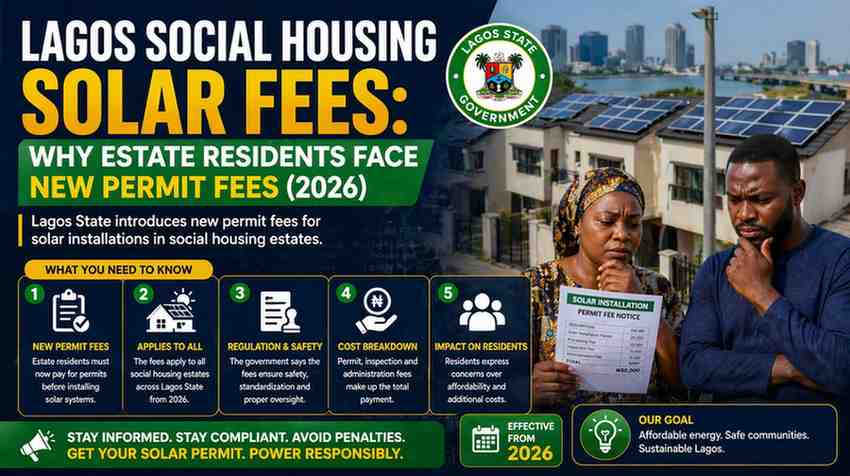
The Lagos State Government has finally spoken out on the popular “Solar Tax” topic.
This week, a video emerged of officials interrogating a resident about solar panel at the Ibeshe Millennium Housing Estate, sparking countrywide indignation.
Stay updated: Set GistReel as a favorite source on Google to catch our stories first.
Many Nigerians are now concerned that a new tariff on renewable energy is being imposed across the state.
However, the Ministry of Housing has underlined that this is not a one-size-fits-all tax on Lagosians.
The “Solar Tax” is simply an administrative cost for structural changes on government-owned properties.




This ban does not apply to residents in Ikeja, Lekki, or Surulere who live in privately owned buildings.
Why Lagos is Charging for Solar Panels
The Permanent Secretary of the Ministry of Housing, Abdulhafis Toriola, stated that these developments constitute “social housing.”
Most of these structures have between two and 32 families per block.
Because the roofs and walls are common infrastructure, one person’s solar installation might have an impact on the entire community.
The Ministry warns that illegal installations have resulted in leaking roofs and even fires.
To avoid this, the government now needs a formal “Approval for Alteration” before any panels are installed.
Lagos social housing solar fees and Permit
Residents of state-owned estates must now submit their solar plans to the Physical Planning and Survey departments.
This is to verify that the cables used are of excellent quality and that the technicians are certified.
There is a necessary administrative cost associated with this inspection and permission.
According to officials, this obligation was already outlined in the “Letter of Allocation” that tenants signed when they purchased the units.
The government warns that any unapproved installation would be noted for “regularization,” which could result in penalties.
Clarification For Private Homeowners
Wale Ajetunmobi, Senior Special Assistant to the Governor, stressed the exception for private property owners.
“The state does not impose solar installation fees on all residents,” Ajetunmobi explained.
The policy is purely a facility management guideline for government assets.
However, many experts caution that even “administrative fees” may inhibit the switch to renewable energy.
With Nigeria’s grid still unstable, solar power has become the lifeline of the middle class.