5 New Nigeria BVN security changes you must know before May 1
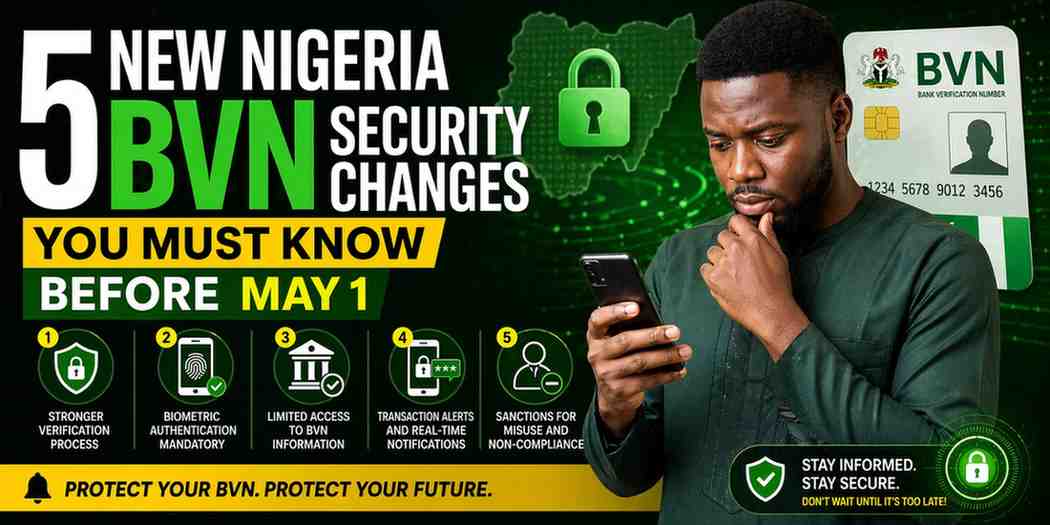
In recent weeks, reports concerning new Bank Verification Number (BVN) guidelines released by the Central Bank of Nigeria (CBN) have spread rapidly on social media.
For example, florathedigitalbanker, an Instagram user, highlighted one facet of the policy, specifically the tightening of rules concerning phone number modifications, ahead of the May 1, 2026, implementation date.
Stay updated: Set GistReel as a favorite source on Google to catch our stories first.
However, such publications only cover a small portion of the broader policy changes, omitting numerous critical elements that directly affect how millions of Nigerians access, update, and manage their bank accounts.
The updated BVN framework includes numerous modifications that have far-reaching consequences for financial access, data management, and fraud protection.
These modifications are among the most significant updates to Nigeria’s financial identity system since the BVN was established in 2014.




Designed to reduce fraud, strengthen identity management, and improve the integrity of the banking system, the new framework also places more responsibility on bank clients while strengthening regulatory monitoring.
With nearly 60 million Nigerians enrolled in the BVN system, the effects of these revisions would be widespread.
Given the restricted scope of certain circulating stories and the growing demand for clarity, DUBAWA decided to provide an overview that describes the significant BVN rule changes, what they mean, and how they may affect bank customers across the country.

1. One-Off Phone Number Change Rule
One of the most significant Nigeria BVN security changes is the restriction on how frequently a client can change the phone number associated with their BVN.
Individuals can only amend their registered phone number once in their lifetime, according to the new legislation.
This is a significant break from the former practice, which allowed consumers to adjust their phone numbers several times with ease.
The CBN implemented this policy because phone numbers are essential for banking authentication processes such as one-time passwords (OTPs), transaction notifications, and account recovery codes.
The apex bank hopes to curb fraud associated with SIM swaps and identity theft by limiting alterations.
However, this means that buyers must use considerable caution while making the one permissible alteration.
Losing access to a registered phone number following the update may cause major complications in accessing banking services.
2. Implementing a 24-Hour BVN Fraud Watchlist
Another significant innovation is the implementation of a temporary BVN watchlist for suspect transactions.
Financial institutions must now report and add BVNs to a watchlist for up to 24 hours if they notice unusual or potentially fraudulent activities.
During this time, transactions involving the BVN may be delayed or restricted as the bank contacts the account holder for verification.
This introduces a real-time fraud monitoring system that enables banks to halt questionable transactions before cash is sent.
While this increases security, it may cause valid transactions, particularly those with high value or urgency, to be delayed.
Customers must now be approachable and ready to confirm transactions when notified.
3. Minimum age requirement. Set at 18 years.
The CBN has also implemented a tougher age barrier for BVN enrollment, limiting registration to those aged 18 and older.
Minors were previously allowed to enroll under specific conditions, but this new rule officially prohibits them from the BVN system.
The implication is that children and teenagers will no longer have independent BVNs and will instead rely on accounts maintained by their parents or guardians.
This policy connects the BVN system with legal criteria of adulthood and seeks to simplify identity verification in the banking industry.
4. Restricted Access to BVN Database
The redesigned framework limits access to BVN data. According to the CBN, only licensed financial institutions can handle or access the database, decreasing the danger of data breaches and personal information misuse.
In practice, this implies that clients will now have to go through their banks or other licensed organizations to resolve BVN-related issues, such as updating personal information.
Some persons formerly relied on informal routes or third-party support, but these are no longer part of the process.
The adjustment represents a move toward tighter controls and more formal procedures for managing BVN data.
5. Stricter Enrollment and Identity Management Framework
Beyond individual restrictions, the CBN has tightened the BVN framework as a whole, with a focus on data quality, identity consistency, and fraud prevention.
This includes tougher Know Your Customer (KYC) regulations, increased examination of customer data, and more structured procedures for updating or amending BVN information.
Financial institutions are obligated to maintain accurate and reliable customer data at all times.
For clients, this means that inaccuracies or discrepancies in BVN records may result in immediate restrictions on account access, loans, or other financial services.
Individuals are increasingly taking on the task of preserving correct records.
What These Changes Mean to Nigerians
Taken collectively, these five shifts represent a transition from a flexible identity system to a high-security financial identity regime.
The BVN is no longer only a registration requirement; it is evolving into a permanent, strictly controlled digital identity linked to all financial transactions.
For everyday users, this would imply increased responsibility. Customers must ensure that their BVN information, particularly their phone number, is accurate, secure, and up to date before the May 1 deadline.
Failure to do so may result in limited access to funds, delayed transactions, and trouble addressing banking concerns.
On a broader scale, the revisions reflect the CBN’s efforts to tackle burgeoning digital fraud and boost trust in Nigeria’s financial system.
While the measures may cause hardship in the near term, they are intended to result in a safer and more transparent banking system in the long run.