Wole Soyinka Biography: The Complete Life of Nigeria’s First Nobel Prize Winner
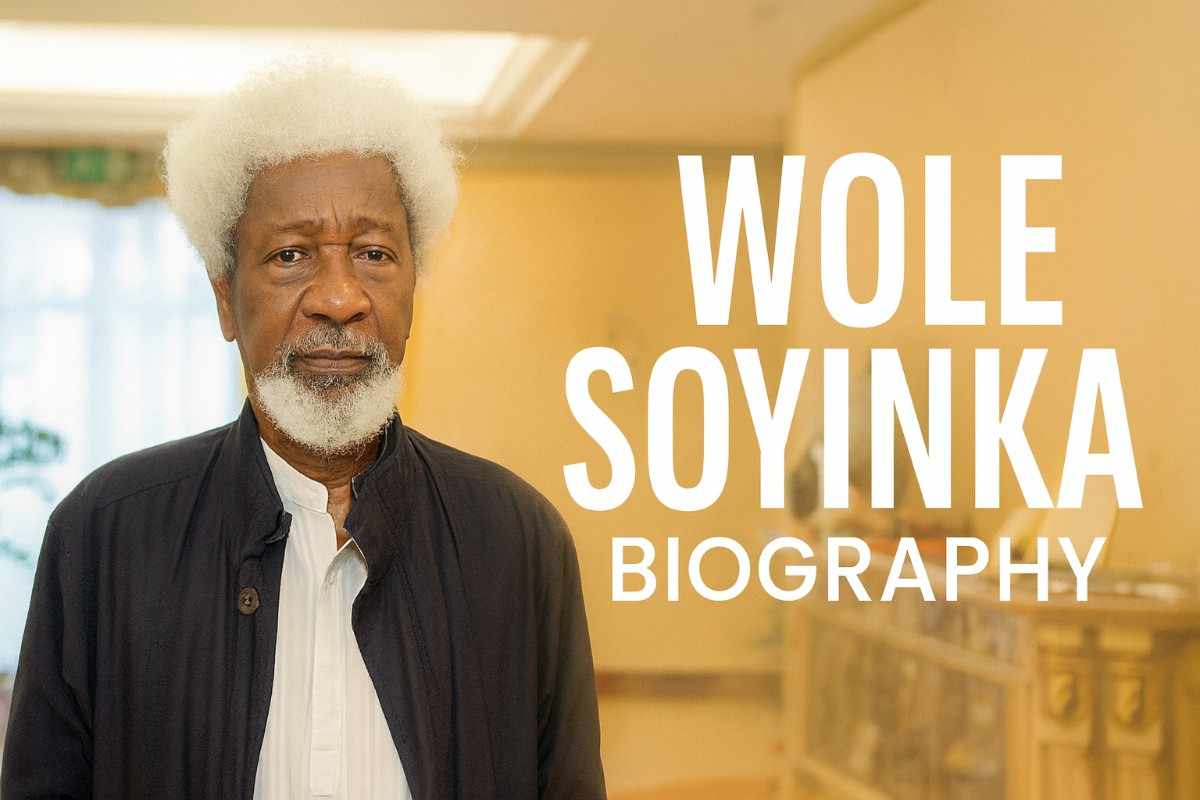
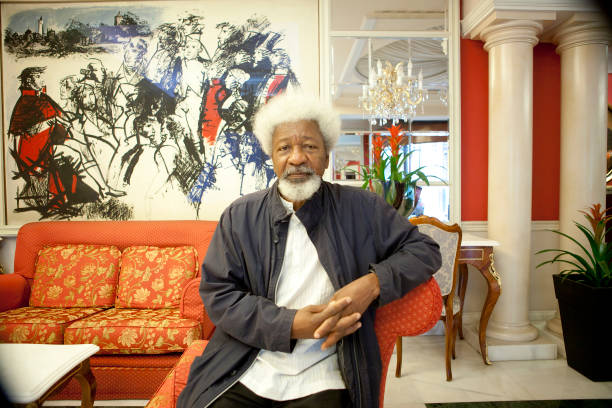
Wole Soyinka was born in Nigeria and studied in England. In 1986, the dramatist and political activist became the first African to earn the Nobel Prize in Literature. He dedicated his Nobel Prize acceptance speech to Nelson Mandela. Soyinka has written hundreds of works, including drama, novels, essays, and poetry, and colleges around the world seek him out as a visiting professor.
Wole Soyinka Biography
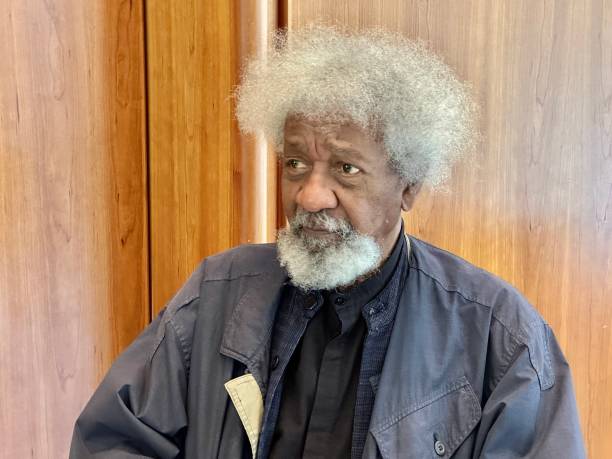
Wole Soyinka was born Akinwande Oluwole “Wole” Babatunde Soyinka on July 13, 1934, in Abeokuta, near Ibadan, Western Nigeria. His father, Samuel Ayodele Soyinka, was a well-known Anglican preacher and headmaster. His mother, Grace Eniola Soyinka, known as “Wild Christian”, was a shopkeeper and community leader.
As a child, he lived in an Anglican mission compound, where he learnt both his parents’ Christian beliefs and his grandfather’s Yoruba spiritualism and tribal practices. Wole, a smart and inquisitive child, caused adults in his life to warn each other: “He will kill you with his questions.”
Wole Soyinka Education
Soyinka attended St Peter’s Primary School, where his father was the headmaster, from 1940 to 1946. From 1946 to 1951, he attended Abeokuta Grammar School for secondary education and Government College in Ibadan for university preparation.
He was enrolled at University College Ibadan, where he studied English literature, Greek, and Western history between 1952 and 1954. During his last years at university, he authored Keffi’s Birthday Treat, a short radio play for the Federal Radio Corporation of Nigeria, which aired in July 1954.

Soyinka co-founded the National Association of Seadogs, Nigeria’s first confraternity, with classmates Olumuyiwa Awẹ, Ralph Opara, Aig-Imoukhuede, and Pius Olegbe. Soyinka moved from Nigeria to England, where he studied English literature at the University of Leeds from 1954 to 1957, under the guidance of G. Wilson Knight, and graduated in 1958.
At Leeds, he was the editor of The Eagle, the university’s satirical journal, where he penned a column about academic life and frequently ridiculed his classmates. In August 1955, he began recording for the BBC Lecture. He also published several short stories, and in 1957, he won the university’s annual oratory competition.
Career
Soyinka stayed in Leeds to earn his master’s degree. He created and published his debut play, The Swamp Dwellers, in 1958. A year later, he released another drama, The Lion and the Jewel. Members of London’s Royal Court Theatre expressed a strong interest in the comedy play.
Soyinka relocated to London and worked as a play reader at the Royal Court Theatre. During that time, he presented two plays in Ibadan, Nigeria, which examined the challenging interplay between progress and tradition in Nigeria.
His play The Invention, which premiered at the Royal Court Theatre in 1957, was his first to gain such acclaim. He wrote poetry like “The Immigrant” and “My Next Door Neighbour”, which appeared in Black Orpheus.
Soyinka returned to Nigeria after earning a Rockefeller study fellowship to conduct a study on African theatre. In November 1959, he replaced Janheinz Jahn as co-editor of Black Orpheus and produced The Trials of Brother Jero, which premiered in April 1960 at University College Ibadan’s Mellanby Hall. In the same year, his piece A Dance of the Forest was designated as the national play for Nigerian Independence Day, and it premiered in Lagos on October 1, 1960.
Soyinka’s first full-length drama, My Father’s Burden, was directed by Olusegun Olusola and premiered on Western Nigeria Television on August 6, 1960. With the Rockefeller funding, Soyinka purchased a Land Rover and began travelling throughout Nigeria as a researcher from the University College Ibadan’s English Language department.
In a 1960 essay, he condemned Leopold Senghor’s Négritude movement as “a nostalgic and indiscriminate glorification of Black African history that ignores the potential benefits of modernisation.” Soyinka contributed writings defending Nigerian literacy, including “Death and the King’s Horsemen” and “Towards a True Theatre” (1962), which were published in Transition Magazine.
Soyinka, a lecturer at Obafemi Awolowo University in Ife, talked about current affairs with Negrophiles and publicly attacked government restrictions. His first feature-length film, Culture in Transition, was released in late 1963. Andre Deutsch published his book The Interpreters in London in 1965. Soyinka and other professionals created the Drama Association of Nigeria.
In 1964, he resigned from his academic post in protest of the authorities’ imposed pro-government conduct. In 1965, he was arrested for the first time, charged with holding up a radio station at gunpoint – about which he would later write in his 2006 memoir, You Must Set Forth at Dawn – and replacing a tape of a recorded speech by the Western Region premier with a different tape containing accusations of electoral malpractice.
He was released after several months of detention following protests from the international writer community. In the same year, he wrote two more dramatic works, Before the Blackout and Kongi’s Harvest. He also wrote The Detainee, a radio piece for BBC London.
On September 14, 1965, his drama The Road debuted in London at the Commonwealth Arts Festival and the Theatre Royal Stratford East. Soyinka was promoted to senior lecturer at the University of Lagos’ Department of English Language.
From 1975 to 1999, Soyinka taught comparative literature at Obafemi Awolowo University. From 1988 until 1991, he was the Goldwin Smith Professor of African Studies and Theatre Arts at Cornell University in the United States.
In 1996, he was named Emory University’s Robert W. Woodruff Professor of the Arts, and he has also taught creative writing at the University of Nevada, Las Vegas. Soyinka has been a scholar-in-residence at both New York University’s Institute of African American Affairs and Loyola Marymount University in Los Angeles, California.
He has also lectured at the Universities of Cambridge, Oxford, Harvard, and Yale. He was a Distinguished Scholar in Residence at Duke University in 2008.
Soyinka got the Europe Theatre Prize in the “Special Prize” category in December 2017, which is given to someone who has “contributed to the realisation of cultural events that promote understanding and the exchange of knowledge between peoples”. Soyinka began serving as Professor of Theatre at New York University Abu Dhabi on September 1, 2022.
Awards and Honours
Soyinka won the Anisfield-Wolf Book Award twice: in 1983 and 2013. He declined an honorary degree from the University of Ibadan. In 1986, he received both the Nobel Prize in Literature and the Agip Prize for Literature. Ibrahim Babangida, the military head of state, also appointed him Commander of the Order of the Federal Republic.
Soyinka is a tribal aristocrat who has the authority to use the Yoruba title ‘Oloye’ as a prenominal epithet. In 2005, he was appointed Egbaland’s “Akinlatun” chieftain. He received the Golden Plate Award from the American Academy of Achievement. Archbishop Desmond Tutu, a member of the Awards Council, gave it to him at St George’s Cathedral in Cape Town.
In 2018, his alma mater, the University of Ibadan, renamed its arts theatre Wole Soyinka Theatre. In 2017, he got the Special Prize category of the European Theatre Prize in Rome. In August 2024, Cuba’s President Miguel Diaz-Canel awarded Soyinka the Haydée Santamaría medal.
President Bola Ahmed Tinubu renamed the National Theatre the Wole Soyinka Centre for Culture and Creative Arts on October 1, 2025, to commemorate Nigeria’s 65th Independence Day. The event was attended by dignitaries from several fields, including government, business, traditional, and creative.
Wole Soyinka Books
- Three plays (The Swamp Dwellers, The Trials of Brother Jero, The Strong Breed) (1963)
- A Dance of the Forests (1963).
- The Lion and the Jewel (1963).
- The Road (1965).
- Kongi’s Harvest (1967).
- Madmen and Specialists (1971)
- The Bacchae of Euripides: A Communion Rite (1973)
- The Jero plays (1972)
- Collected Plays, Volume I (1973)
- Collected Plays, Volume II (1974).
- Death and the King’s Horseman (1975). Eyre Methuen: London. ISBN 9780413333506
- The Republican (1964)
- Before the Blackout (1965). Orisun Editions: Ibadan, Nigeria.
- My Father’s Burden (6 August 1960). Western Nigerian TV
- The Tortoise (18 December 1960). Nigerian Radio Times
- Camwood on the Leaves (1973). Eyre Methuen: London.
- The Detainee (5 September 1965). BBC African Service
Personal Life
Soyinka has been married three times. He married British writer Barbara Dixon in 1958, Nigerian librarian Olaide Idowu in 1963, and his present wife, Folake Doherty, in 1989. Soyinka disclosed in 2014 that he was diagnosed with prostate cancer and was cured after 10 months of therapy.
Net Worth
Wole Soyinka is a hugely recognised dramatist in Nigeria, Africa, and around the world, with an estimated net worth of $5 million. Literary figures like Soyinka often make money via book sales, speaking engagements, university positions, and awards.