“People in power think and arrogantly behave like gods” — Ex-Senator Shehu Sani

Former federal lawmaker Senator Shehu Sani has sparked fresh debate after issuing a stern warning to those in authority, saying power often blinds leaders to its temporary nature.
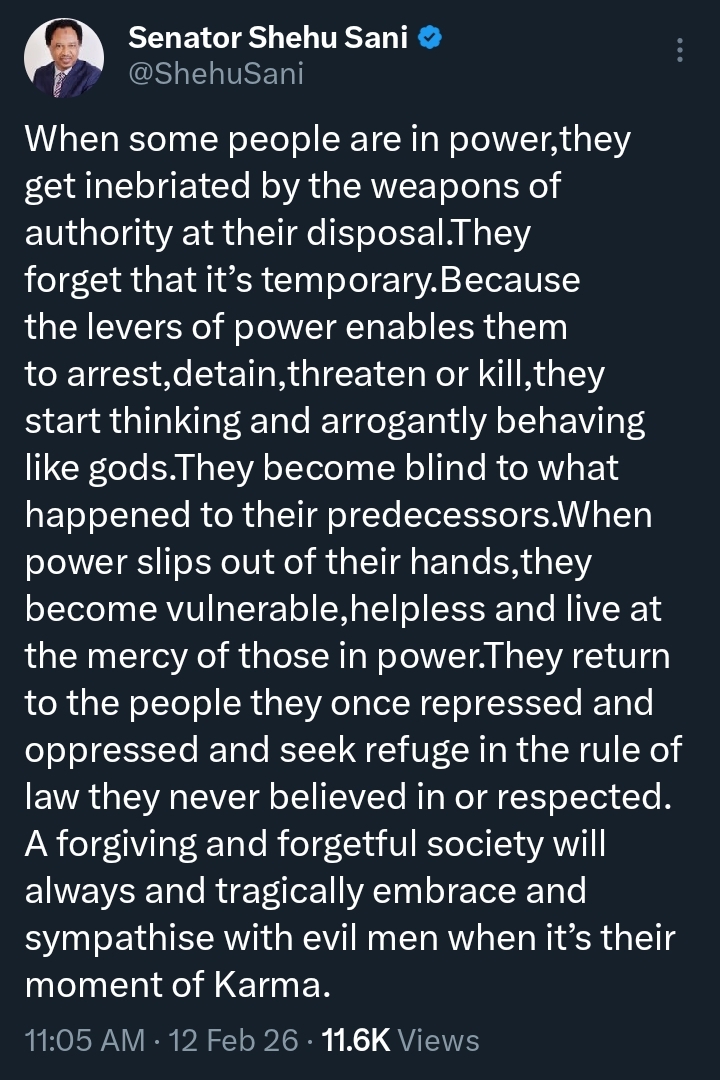
In a statement posted on X, formerly Twitter, the outspoken politician reflected on how public office can intoxicate those who wield it, urging leaders to remember that authority is never permanent.
‘Weapons of Authority’ and Arrogance
Sani wrote that some individuals become “inebriated by the weapons of authority at their disposal” once they assume office. According to him, access to state power, including the ability to arrest, detain or threaten, can create a false sense of invincibility.
He warned that such leaders begin “thinking and arrogantly behaving like gods,” forgetting what happened to those who held power before them. In his view, many become blind to history and dismiss the idea that their tenure could one day end.
The former senator added that when power eventually “slips out of their hands,” the same individuals become vulnerable and helpless.




He noted that they often turn to the rule of law for protection, despite having shown little respect for it while in office.
Sani also criticised what he described as a “forgiving and forgetful society,” arguing that such an environment allows former leaders to regain sympathy even after alleged abuse of power.
He concluded that this cycle tragically enables “evil men” to escape lasting accountability when their moment of reckoning arrives.
Mixed Reactions from Nigerians
The statement quickly drew varied reactions from social media users, many of whom weighed in on Nigeria’s political culture.
A user identified as Man Like Me disagreed with Sani’s position, arguing that political consequences rarely follow loss of office in Nigeria.
“That sounds good in theory. But in Nigeria, it doesn’t play out like that. Politicians don’t really fall. They switch sides. Out of power today, aligned tomorrow.
“They protect each other, cover each other, defend each other whether in office or not. Here, it’s not karma. It’s coalition,” he wrote.
Another commenter, Charles Igwe, said: “What struck me most was your point about a forgetful society. The same people these men in power oppressed and denied good governance will still sympathize with them once they’re out of office. A few names already come to mind.”
Mohammed, another user wrote: “Your statement reminds me of an ancient classic poem I read many years ago. ‘The proud King’ by William Moris, the major themes of the poem clearly reflect the attitude of many Nigerian leaders today. When they’re in power, they act like ancient Roman and Greek leaders.”
Ademola also reflected on the nature of authority, stating, “Power has a way of revealing character more than building it. History keeps teaching the same lesson authority is temporary, accountability is inevitable.”
He further wrote, “When leaders forget that power is borrowed from the people, they mistake fear for loyalty and silence for support. But time has no permanent favorites.
“The real tragedy isn’t just the fall of arrogant rulers it’s when society forgets too quickly and repeats the cycle. Justice without memory is just a pause before the next abuse.”