Nnamdi Kanu Biography: Early Life, Career, IPOB Leadership & Controversies
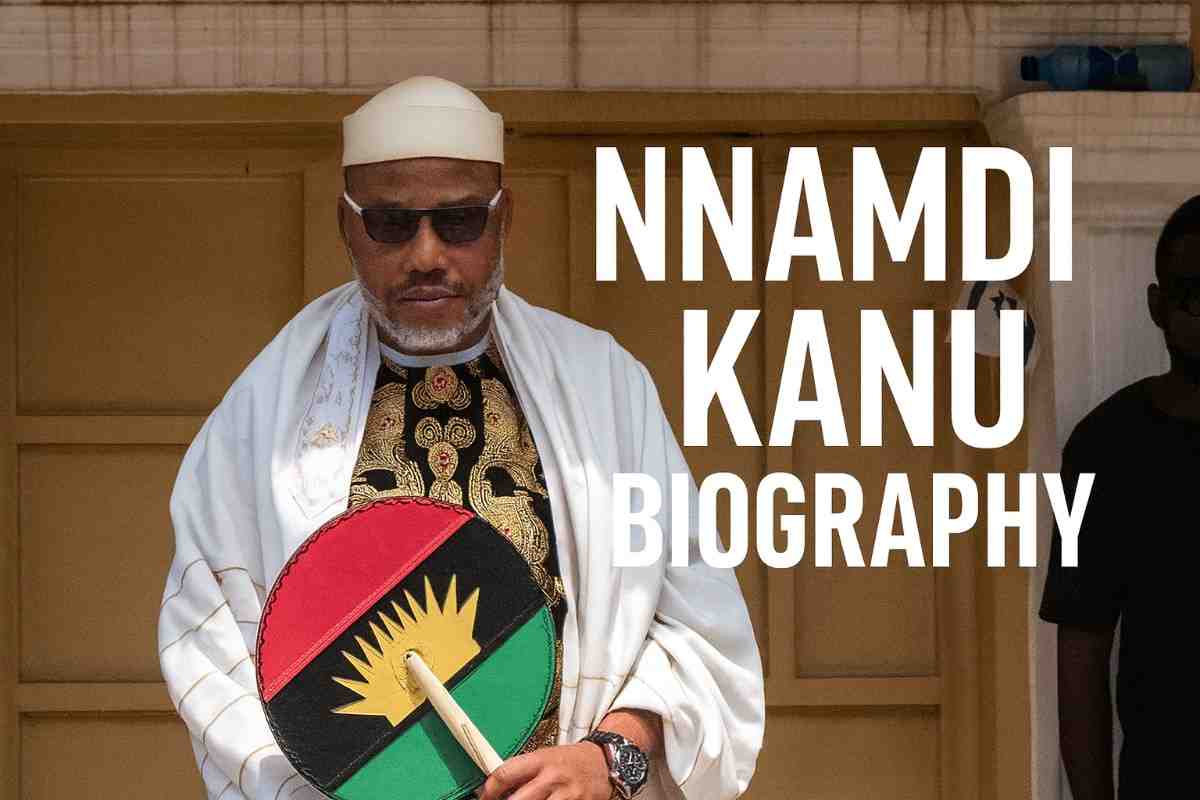
Nnamdi Kanu (born September 25, 1967) is a British-born political activist who advocates for the independence of Biafra from Nigeria. He is the leader and creator of the Indigenous People of Biafra (IPOB), which he established in 2012 to revive the defunct State of Biafra that existed in Nigeria’s Eastern Region during the Nigerian Civil War.
Kanu promoted Biafran separatism as director of Radio Biafra, a radio station registered in the United Kingdom. He was arrested on treason accusations in Lagos, Nigeria, on October 14, 2015, and jailed for more than a year, despite many court orders for his release. Kanu often appeared in court with a Jewish prayer shawl and head covering. He stated in court that he “believes in Judaism” and identifies as a Jew. On several occasions, he has led his Biafran people in Jewish prayers and religious observances.
On April 28, 2017, Kanu was released from prison on bail. Nigerian security forces sought to dismantle IPOB’s armed wing, the Eastern Security Network, resulting in a low-level battle in early 2021. Despite the fighting, Kanu stated that IPOB sought a peaceful approach to achieve Biafran independence without violence or injury. In June 2021, he was widely reported to have been re-arrested by Interpol in Kenya and handed over to Nigeria; however, in April 2024, Interpol denied any involvement in the arrest and subsequent rendition.
Nnamdi Kanu Biography
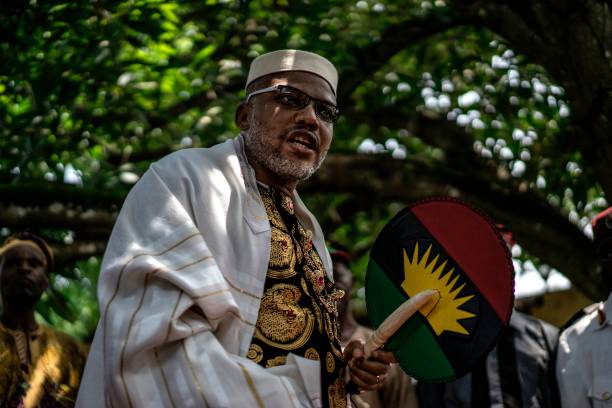
Kanu was born on September 25, 1967, in Isiama Afara Ukwu, Umuahia, within the Republic of Biafra’s claimed territory, a few months after the country declared independence from Nigeria. His father, Eze Israel Okwu Kanu (JP), and mother, Ugoeze Nnenne Kanu, were Nigeria’s traditional monarchs. He attended Library Avenue Primary School before continuing his schooling at Government College, Umuahia. He attended the University of Nigeria, Nsukka, and later relocated to the United Kingdom before graduating.
Career
Kanu began his activism for Biafra’s freedom as a Radio Biafra director and Biafra awareness anchor under Ralph Uwazuruike, leader of the Movement for the Actualisation of the Sovereign State of Biafra (MASSOB), who stated in a meeting in Kaduna, Nigeria, on June 12, 2014, that he handed over Radio Biafra to Nnamdi Kanu, leader of IPOB, but Kanu disappointed him.


However, the defunct Biafran government founded Radio Biafra in 1967 to promote the Biafran cause. Kanu was a relatively unknown figure until 2009, when he founded Radio Biafra, a program broadcasting to Nigeria from London and advocating for an independent state for the Igbo people.
In 2014, he formed the IPOB. Nnamdi Kanu was a guest speaker at the World Igbo Congress in Los Angeles on September 5, 2015, telling his audience that “we need guns and we need bullets.” On October 18, 2015, it was reported that Kanu had been detained in Lagos State by Nigeria’s secret police, the Department of State Services.
Kanu told his solicitors that on October 14, 2015, he was arrested by agents of the Federal Government of Nigeria’s State Security Service (SSS) in his hotel room at the Golden Tulip Essential Hotel, Ikeja, Lagos State. On October 19, 2015, it was announced that Nnamdi Kanu was granted bail following a private arraignment at the Magistrate Court in Wuse 11.
However, the bond appeared “controversial”, with claims that the DSS announced it just “to calm the angry people of Biafra.” On November 18, 2015, Magistrate Court 1 in Abuja ordered the Department of State Services (DSS) to present Kanu before the court on November 23, 2015. However, it was alleged that the Department of State Services (DSS) acquired a “secret court order to detain Nnamdi Kanu”.
In an interview, Kanu’s lawyer, Vincent Obetta, stated that while in court, the prosecutor handed him a document containing a court order authorising the Department of State Services (DSS) to detain Kanu for the next three months to “conclude what they said was an investigation of terrorism and terrorism financing”.
Nigeria’s Department of State Services (DSS) finally charged Kanu with “criminal conspiracy, intimidation, and membership in an illegal organisation” in an Abuja Magistrate Court on November 23, 2015. The charges contravene “Sections 97, 97B, and 397” of Nigeria’s penal code.
Kanu, through his counsel, applied to the federal authorities requesting that he be transferred from the custody of the Department of State Services (DSS) to prison. His lawyer, Obetta, believed that moving his client to prison would allow him to easily communicate with his legal team.
While in court, the Department of State Services (DSS) asked the Wuse Zone 2 Senior Magistrates’ Court to end Nnamdi Kanu’s trial under Section 108(1) of the Administration of Criminal Justice Act 2015. Idakwo went on to say that the Department of State Services (DSS) secured an order from the Federal High Court in Abuja on November 10 to detain the accused for 90 days.
However, Kanu’s lawyer, Obetta, opposed his client’s continuing imprisonment. Obetta petitioned the court not to dismiss the case since the prosecution failed to produce any information from the Attorney-General of the Nigerian Federation, who had the ability to approve it.
Obetta additionally advised the jury that “the DSS violated the order of the court, which granted bail that was perfected but not granted,” adding that the accused had been in Department of State Services (DSS) custody since he was arrested. After hearing both counsels, the court’s magistrate, Usman Shuaibu, adjourned the case until December 1, 2015, for a verdict.
Kanu Agabi, the IPOB leader’s counsel, voiced alarm about his client’s deteriorating health, citing medical records revealing liver and pancreatic issues, a mass under his armpit, and low potassium levels. However, a Nigerian Medical Association investigation on Nnamdi Kanu’s health status found that he is fit to continue facing the trial.
In a June 2017 interview, Kanu asked for bullets and guns from a group of Nigerians located in the United States for self-defence against the Fulani herdsmen’s ongoing atrocities on Igbos in Biafran territory.
Before the 2019 presidential election, IPOB threatened to boycott it. According to IPOB leader Nnamdi Kanu, the boycott is a multifaceted approach. It is civic disobedience, silent protest, and a statement of our indignation for Nigeria and everything it represents.” Local Nigerian leaders strongly opposed his views on election boycotts.
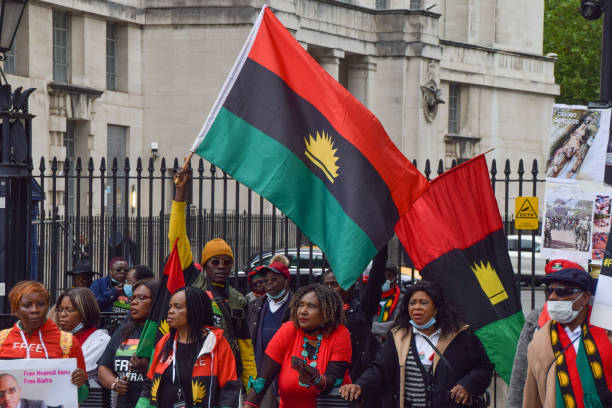
On the eve of the election, Nnamdi Kanu lifted the boycott and invited Biafrans to vote, after which he declared his situation as “signed, sealed, and delivered”. His move was interpreted in many circles as being receptive to the appeals and viewpoints of others.
In December 2020, Kanu declared that IPOB had formed the Eastern Security Network (ESN) to protect southeastern Nigerians against robbers and armed Fulani herdsmen. Kanu later told all governors in southeast Nigeria to ban open grazing in 14 days, threatening to use the ESN to enforce the rule if the government did not comply.
The Nigerian government saw the establishment of a non-state-sanctioned paramilitary organisation as unacceptable and attempted to suppress it. The situation worsened in January 2021, when the Nigerian military was repulsed in an effort to oust the ESN from Orlu, Imo. Before launching another onslaught, Kanu ordered the ESN to retreat to the bush, effectively ending the conflict.
On 18 February, the Nigerian army and air force resumed hostilities against the ESN, and the following day, IPOB declared that Nigeria and Biafra were at war as of that date. IPOB and other Biafran separatist groups then proceeded to mobilise and attack security troops in numerous southern Nigerian states.
Despite this, Kanu stated that IPOB was seeking a nonviolent solution to the war and that ESN was designed to battle robbers, not Nigerian security forces. Regardless, Nigerian authorities declared IPOB a terrorist organisation and alleged Kanu was instigating violence.
On June 27, 2021, Interpol apparently arrested Kanu in Kenya or another location and extradited him to Nigeria, where he is expected to face trial. However, in 2023, Interpol denied involvement in the arrest. Kanu’s brother reported that he had been arrested by Kenyan authorities. Kenyan High Commissioner Wilfred Machage disputed the claim, noting that Kenyan authorities were not involved in the arrest and challenging anyone to show evidence to the contrary. When the BBC sought to contact Interpol’s Abuja office for details, the latter did not respond.
Kanu’s detention has enraged Biafran separatists and other Nigerians sympathetic to his cause. The World Igbo Congress (WIC) described the arrest as “illegal abduction and international gangsterism”. Following his detention, questions were raised about “Kanu’s disregard of the Nigerian constitution” in absconding with bail in 2017. During his arraignment in court on June 29, 2021, Kanu told the presiding judge that the Nigerian military compelled him to escape the country in 2017.
The trial began in October 2021, with Kanu charged with “terrorism, treason, involvement with a banned separatist movement, inciting public violence through radio broadcasts, and defamation of Nigerian authorities through broadcasts”. He pleaded not guilty to all counts. Protests and general strikes were organised by his supporters to coincide with the proceedings.
In December 2023, Nigeria’s Supreme Court renewed terrorism charges against Kanu. As of 2024, his primary counsel is barrister Aloy Ejimakor. In mid-2024, several Nigerian leaders advocated for Kanu’s release. On November 20, 2025, Justice James Omotosho of the Federal High Court of Nigeria condemned Kanu to life in prison after finding him guilty of terrorism and other offences.
Personal Life
Aside from politics, Kanu is married to Uchechi Okwu Kanu, and they have children. He also identifies as Jewish, having conducted Jewish prayers and religious observances. His religious views play an important role in his activism. Nnamdi Kanu’s impact cannot be ignored, whether you love him or detest him.
Net Worth
Nnamdi Kanu’s net worth is reported to be around N100 million, although some sources say it may be as high as $13 million. The British-Nigerian political activist leads the Indigenous People of Biafra (IPOB).