Maria Callas Biographie: Early Life, Career, Films, Husband & Death
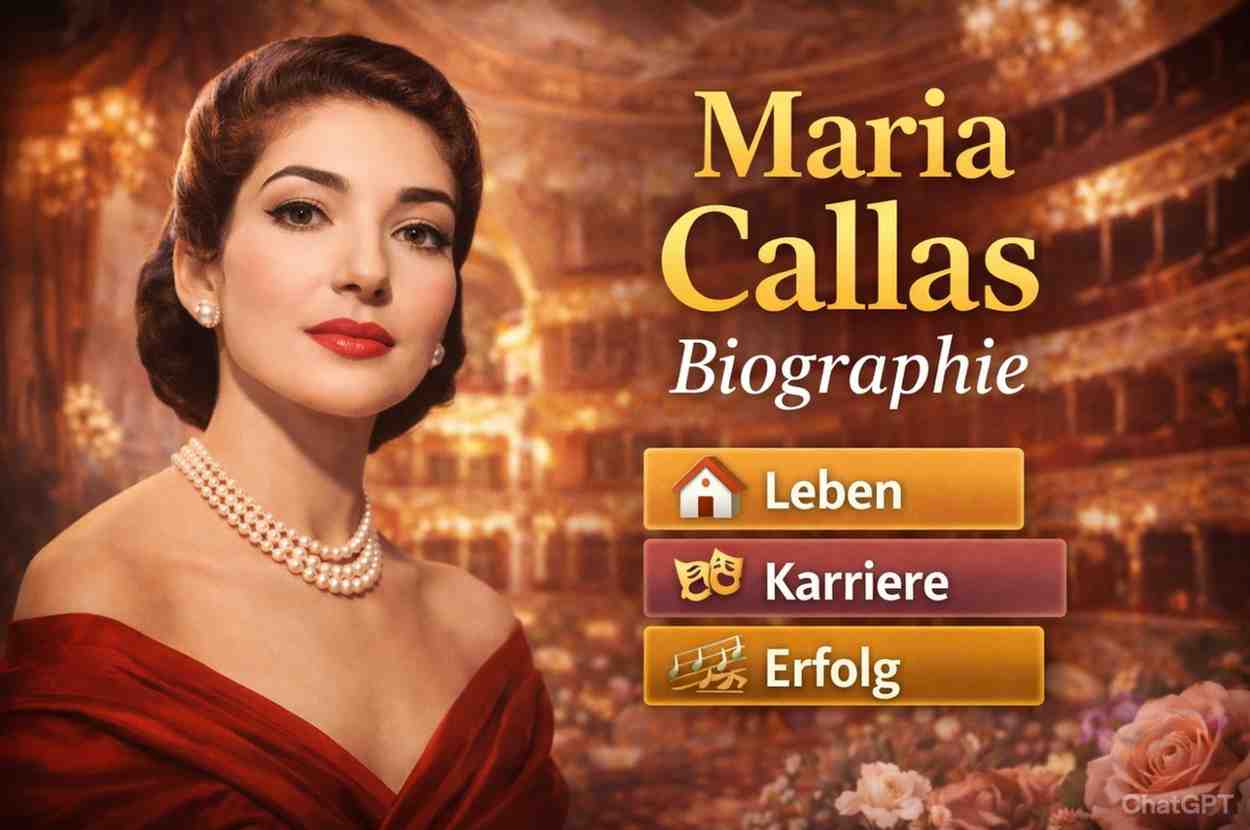
Maria Callas Commendatore OMRI (born Maria Anna Cecilia Sophia Kalogeropoulou; December 2, 1923 – September 16, 1977) was a Greek-American soprano who became one of the 20th century’s most famous and influential opera singers.
Many commentators commended her bel canto technique, versatile voice, and dramatic interpretations. Her repertoire included classical opera seria, bel canto operas by Donizetti, Bellini, and Rossini, as well as works by Verdi and Puccini, and, early in her career, Wagner’s music dramas. Her musical and dramatic talents earned her the title La Divina (“The Divine One”).
Although her dramatic life and personal tragedy have frequently overshadowed Callas the artist in the popular press, her artistic achievements were such that Leonard Bernstein dubbed her “the Bible of opera,” and her influence so enduring that, in 2006, Opera News wrote of her: “Nearly thirty years after her death, she’s still the definition of the diva as artist—and still one of classical music’s best-selling vocalists.” Her ashes were dispersed over the Aegean Sea on June 3, 1979, fulfilling one of her final desires.
Maria Callas Biographie
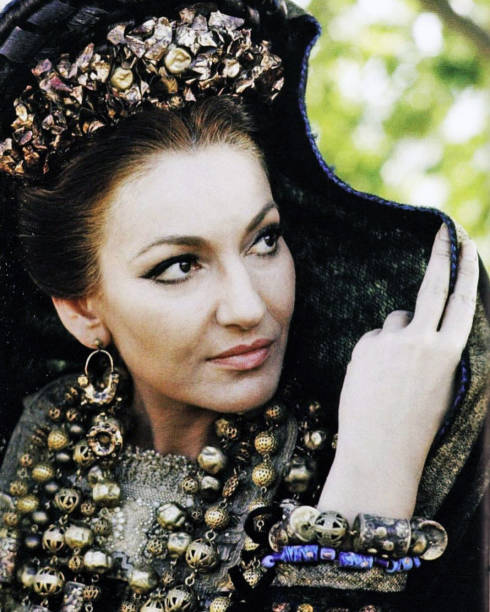
She was born in New York City as the daughter of Greek immigrants Evangelia (“Litsa”). Kalogeropoulos (née Dimitriadou) and George Kalogeropoulos, whose surname was eventually changed to Callas. Maria Callas had a natural ability for singing from a young age, and her mother encouraged her to perform.
Despite her musical abilities, Callas felt overshadowed by her older sister, whom she regarded as her mother’s favourite. Callas’ home life was further strained by her parents’ increasingly tense relationship. Evangelia Callas sent her two children to Athens in 1937, where Maria Callas trained at the National Conservatory and then the Athens Conservatory with singer Elvira de Hidalgo. Callas began singing locally, appearing in works such as Cavalleria rusticana and Boccaccio.



Career
Callas began singing locally, appearing in works such as Cavalleria rusticana and Boccaccio. In 1942, she made her professional debut in a leading role, playing Tosca in Giacomo Puccini’s opera.
Her performance received great acclaim. World War II broke out just as Callas’ career began, and Greece was invaded by the Axis powers in 1941. She later alleged that her mother had forced her to entertain German and Italian soldiers in exchange for money and food.
This strained their connection even more, and by the early 1950s, Callas had largely ceased speaking with her mother.
In 1945, Callas returned to the United States. Her professional career began in earnest in August 1947, when she starred in La Gioconda at the Arena in Verona, Italy. She made her debut in Venice, Turin, and Florence shortly after being tutored by conductor Tullio Serafin.
She had her debut appearances in Rome, Buenos Aires, and Naples in 1949, followed by Mexico City in 1950. These performances earned Callas the nickname “La Divina” (“The Divine One”).
Callas’s rise to the forefront of contemporary opera was aided in large part by her powerful, dramatic soprano voice, which could sustain both lyric and coloratura roles. Her success was partly credited to her strong sense of theatre and extremely high creative standards, which helped her gain the title of diva.
Her powers enabled the rebirth of 19th-century bel canto compositions, particularly those by Vincenzo Bellini and Gaetano Donizetti, which had long been excluded from traditional repertoires.
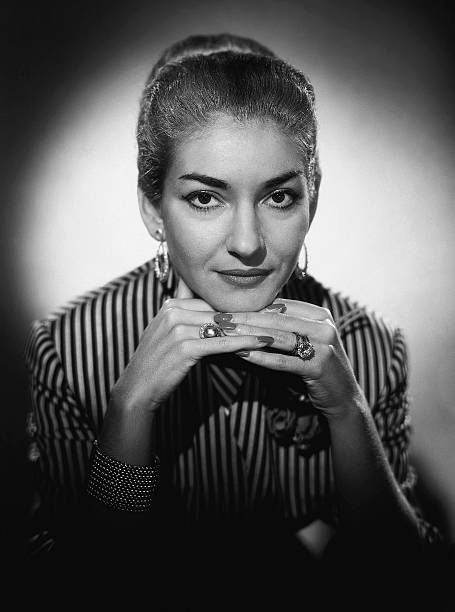
In 1950, Callas made her debut at Milan’s famed La Scala, singing I Vespri siciliani. Two years later, she appeared in Covent Garden, London.
Her American debut was in November 1954 at Chicago’s Lyric Opera in the title role of Norma, which she reprised in front of a record audience at the Metropolitan Opera in New York City. Callas’ albums were well appreciated, and she was one of the most popular vocalists at the time.
By the late 1950s, Callas was experiencing voice difficulties, most notably unevenness in higher registers. While some attributed her troubles to her rapid weight loss around 1954, others blamed earlier “heavy” roles, which are vocally demanding and require the singer to sing loudly and with power.
Callas blamed a lack of strength in her diaphragm. Whatever the reason, in the 1960s, she began to reduce her performances.
Callas made the film Medea in 1969, following her final operatic performance as Tosca at London’s Covent Garden in 1964. In 1966, she became a Greek citizen and gave up her US citizenship. She taught opera master classes at Juilliard in 1972 before embarking on her final concert tour of the United States and Europe in 1973-74.
By the time she retired, she had played over 40 different roles and recorded more than 20 full operas.
Filmography
- Adieux de Tabarin
- Mona Lisa
- Callas Walking Lucia
- Medea Medea Pier Paolo Pasolini
- The Beautiful Face
Marai Callas Husband
In 1949, Callas married Giovanni Battista Meneghini, who was 20 years her senior. He was a successful brick producer who later sold his firm to become her manager. In 1959, Callas left Meneghini for Aristotle Onassis, a Greek shipping mogul.
Their romance ended in 1968, when Onassis married Jackie Kennedy, other accounts indicate that Callas and Onassis continued to see each other.
Maria Callas Cause of Death
Callas died on September 16, 1977, of a heart attack; she was 53 years old. Four days following her death, Callas’ funeral was held at Paris’ Saint Stephen’s Greek Orthodox Cathedral. Maria Callas’ body was cremated, and her ashes were initially stored in the Columbarium at Père Lachaise Cemetery in Paris.