Hantavirus: What to know about the illness suspected in a cruise ship outbreak
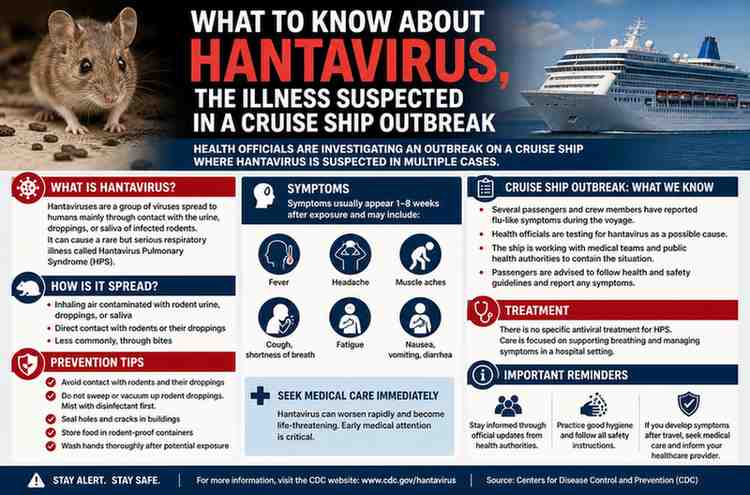
According to studies, hantavirus has existed for centuries, with epidemics documented in Asia and Europe. In the Eastern Hemisphere, it has been associated with hemorrhagic fever and kidney failure.
It wasn’t until the early 1990s that a previously unknown group of hantaviruses was discovered in the southwestern United States, producing an acute respiratory condition known as hantavirus pulmonary syndrome.
Stay updated: Set GistReel as a favorite source on Google to catch our stories first.
Betsy Arakawa, the wife of the late actor Gene Hackman, died from a hantavirus illness in New Mexico in 2025, bringing attention to the disease.
The World Health Organisation said in a statement Sunday that detailed investigations into the cruise ship incident are still underway, including additional laboratory tests and epidemiological investigations. Virus sequencing is also ongoing.
The virus is transmitted by rodents aless commonlyrely, and humans. Hantavirus is mostly transmitted through contact with rodents or their urine, saliva, or droppings, especially when the material is disturbed and becomes airborne, creating a danger of inhalation.




People are most commonly exposed to hantavirus in their homes, cabins, or sheds, particularly when cleaning out confined rooms with minimal ventilation or exploring regions with mouse droppings.
According to the World Health Organisation, hantaviruses can pass directly between people, which is rare.
The United States Centers for Disease Control and Prevention began tracking the virus following a 1993 outbreak in the Four Corners region, which includes Arizona, Colorado, New Mexico, and Utah.
An astute physician with the Indian Health Service first recognised a pattern of mortality among young patients, according to Michelle Harkins, a pulmonologist at the University of New Mexico Health Sciences Centre who has spent years researching the disease and assisting sufferers.
The vast majority of instances in the United States occur in Western states. Harkins identified New Mexico and Arizona as hotspots, most likely because of the increased likelihood of mouse-human contact inn rural locations.
Hantavirus begins with flu-like symptoms.

An infection can quickly spread and become life-threatening. Experts say it might begin with symptoms such as a fever, chills, muscle aches, and sometimes a headache.
Symptoms of hantavirus pulmonary syndrome appear one to eight weeks following interaction with an infected mouse. As the illness advances, patients may feel tightness in the chest as the lungs fill with fluid.
The other hantavirus condition, hemorrhagic fever with renal dysfunction, typically occurs after a week or two of exposure.
Death rates vary depending on which hantavirus causes the sickness. According to the CDC, hantavirus pulmonary syndrome kills approximately 35% of those infected, whereas hemorrhagic fever with renal syndrome kills 1% to 15% of patients.
There are many unknowns concerning the condition and therapy. There is no specific therapy or cur; medicalll attention can improve the chances of survival.
Despite years of research, Harkins stated that many concerns remain unanswered, including why it might be moderate in some people and severe in others, as well as how antibodies are generated.
She and other researchers have been studying patients for extended periods of time in the hopes of discovering a therapy.
The easiest strategy to avoid the germ is to limit contact with rodents and their droppings. When cleaning up rodent droppings, wear protective gloves and use a bleach solution. Public health officials warn against sweeping or vacuuming because it can spread viruses into the air.