Full List: CBN revokes operational licenses of 46 microfinance banks
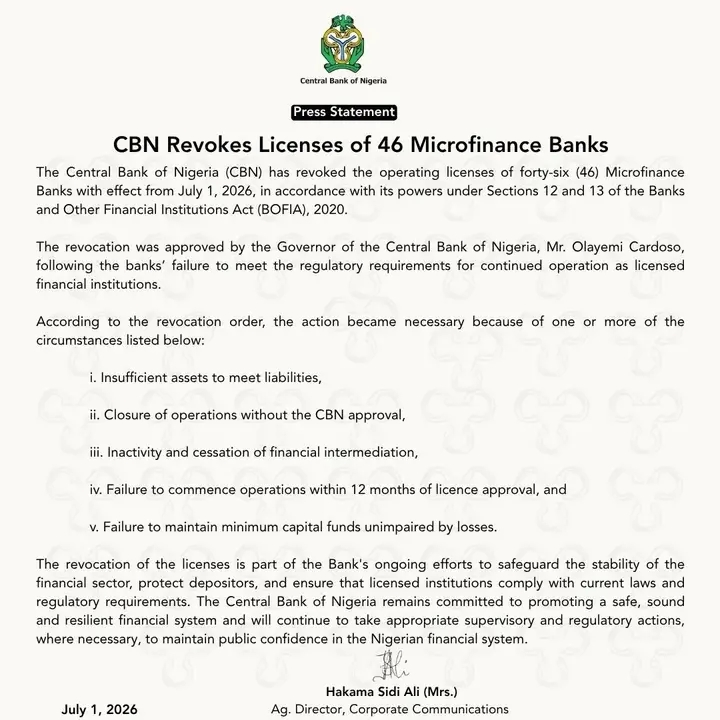
The Central Bank of Nigeria (CBN) has withdrawn the operating licences of 46 microfinance banks in a fresh regulatory move aimed at strengthening oversight of the country’s financial sector.
The decision, which became effective on July 1, 2026, was announced in a statement signed by the Acting Director of Corporate Communications, Hakama Sidi-Ali.
Stay updated: Set GistReel as a favorite source on Google to catch our stories first.
The apex bank said the action was taken under the provisions of the Banks and Other Financial Institutions Act (BOFIA), 2020, following the approval of CBN Governor Olayemi Cardoso.
Why the licences were revoked
According to the CBN, investigations showed that the affected institutions failed to satisfy key conditions required to retain their operating licences.
The regulator explained that some of the banks no longer had enough assets to cover their financial obligations, while others stopped operating or abandoned financial services without obtaining regulatory approval.




It also noted that some institutions failed to begin operations within one year of receiving their licences, while others did not maintain the minimum capital required by law.
The apex bank said the enforcement action is part of its commitment to ensuring that only financially sound and properly managed institutions remain in Nigeria’s banking industry.
It added that protecting depositors and preserving confidence in the financial system remain top priorities.
The CBN reaffirmed that it will continue to monitor licensed financial institutions and will not hesitate to impose sanctions where operators fail to comply with existing regulations.
Full list of affected microfinance banks
1. Minji-Se Churchill MFB (Tier 1) – Rivers State
2. Merchant MFB (Tier 2) – Abia State
3. Janmaa MFB (Tier 1) – Kwara State
4. Busu MFB (Tier 2) – Niger State
5. Gold MFB (Tier 1) – Lagos State
6. Zain MFB (formerly Dawakin Tofa MFB) (Tier 2) – Kano State
7. Bompai MFB (Tier 1) – Kano State
8. Ajwa MFB (Tier 2) – Kano State
9. Now Now Digital MFB (Tier 2) – Kano State
10. Crystabel Microfinance Bank (Tier 1) – Bayelsa State
11. Chanelle MFB (State-based) – Lagos State
12. Abia SME MFB (Tier 1) – Abia State
13. Kamba MFB (Tier 2) – Kebbi State
14. Iwade MFB (Tier 2) – Ogun State
15. Winview MFB (Tier 1) – Abuja (FCT)
16. Zuru MFB (Tier 2) – Kebbi State
17. Minjibir MFB (Tier 1) – Kano State
18. Shanono MFB (Tier 2) – Kano State
19. Sumaila MFB (Tier 2) – Kano State
20. Rimin Gado MFB (Tier 2) – Kano State
21. Mwaghavul MFB (State-based) – Plateau State
22. Sycamore MFB (Tier 2) – Kano State
23. TOFA MFB (Tier 2) – Kano State
24. Safegate MFB (Tier 1) – Lagos State
25. Creekline MFB (Tier 2) – Delta State
26. Bestar MFB (Tier 1) – Oyo State
27. Livingspring MFB (Tier 1) – Cross River State
28. Apple MFB (Tier 2) – Ogun State
29. Stanford MFB (State-based) – Uyo, Akwa Ibom State
30. Frontline MFB (Tier 2) – Anambra State
31. Zafec MFB (Tier 2) – Kaduna State
32. Supreme MFB (Tier 1) – Lagos State
33. Bejin-Doko MFB (Tier 2) – Niger State
34. Kanopoly MFB (Tier 1) – Kano State
35. Bellbank MFB (formerly Tsanyawa MFB) (Tier 2) – Kano State
36. Yeneng MFB (Tier 2) – Plateau State
37. Creditville MFB (Tier 1) – Lagos State
38. MBAG MFB (Tier 1) – Lagos State
39. Straight Sahara MFB (Tier 1) – Benue State
40. Our Pass MFB (Tier 2) – Ondo State
41. VERDANT MFB (Tier 1) – Lagos State
42. Basawa MFB (Tier 2) – Kaduna State
43. Casha MFB (Tier 2) – Abuja (FCT)
44. Esteem MFB (Tier 2) – Kano State
45. Enterpreneur MFB (Tier 1) – Lagos State
46. Avantus MFB (Tier 2) – Osun State
Recapitalisation exercise continues
The licence withdrawals come months after the CBN intensified its banking sector recapitalisation programme.
In March 2024, the regulator introduced higher minimum capital requirements for banks and fixed March 31, 2026, as the compliance deadline.
By March 6, 2026, the CBN announced that 30 banks had successfully met the new capital threshold.
The latest action signals the regulator’s determination to enforce compliance across the financial sector and ensure that institutions operating in the country remain stable, adequately capitalised and capable of protecting customers’ funds.