Bob Dylan Biography: Early Life, Career, Songs, Family & Net Worth
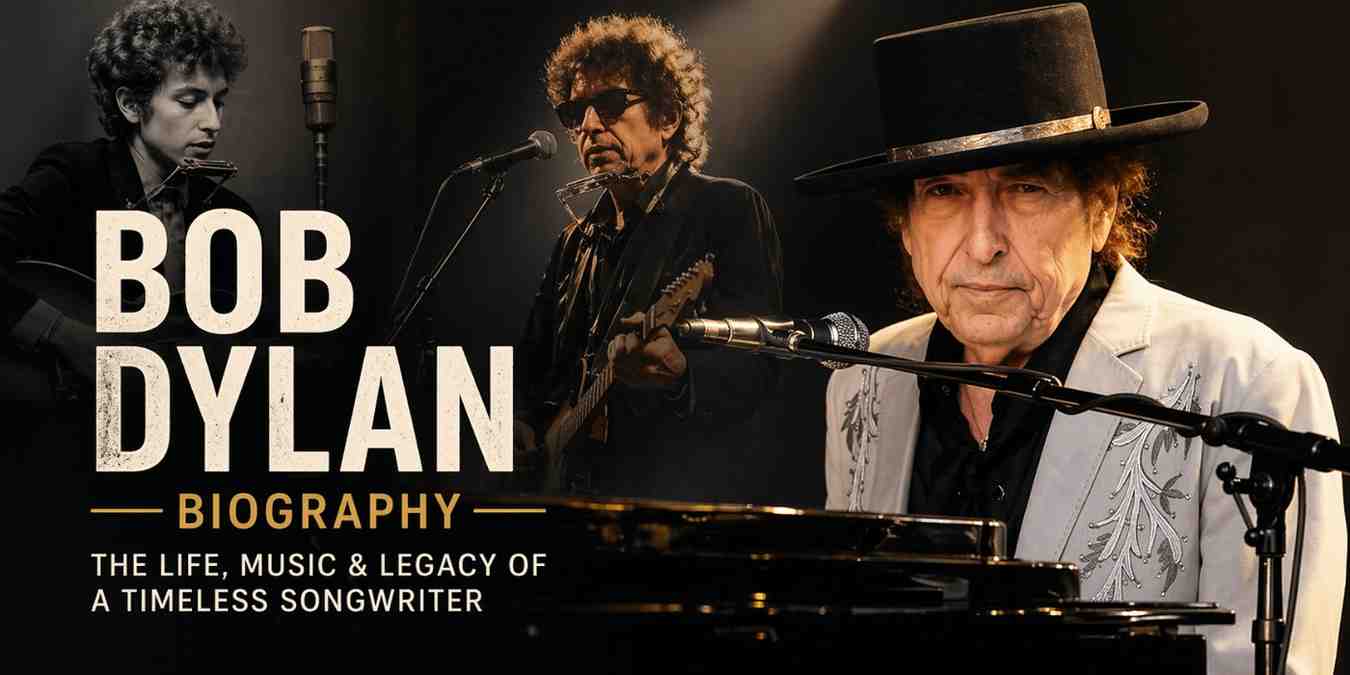
Bob Dylan (born Robert Allen Zimmerman on May 24, 1941) is an American singer and songwriter. Dylan, regarded as one of the greatest composers of all time, has made significant contributions to popular culture over his 69-year career.
He is one of the best-selling musicians, having sold an estimated 125 million records worldwide. Dylan applied increasingly complex lyrical skills to early 1960s folk music, infusing it “with the intellectualism of classic literature and poetry”.
Stay updated: Set GistReel as a favorite source on Google to catch our stories first.
His songs included political, social, and philosophical references, challenging pop music standards and appealing to the rising counterculture.
Bob Dylan Biography
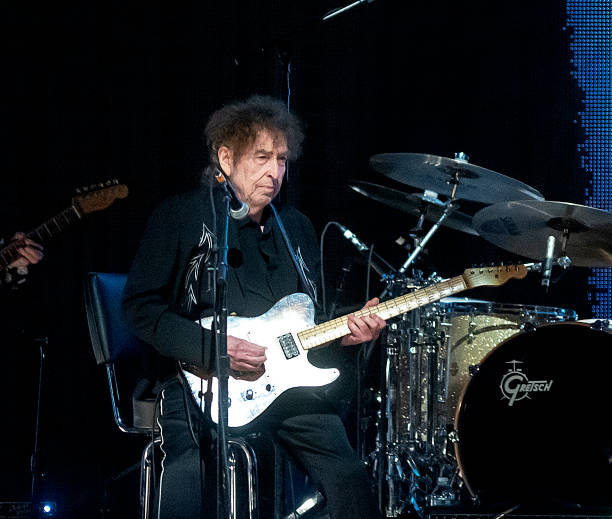
He was raised in the northeastern Minnesota mining town of Hibbing, where his father co-owned Zimmerman Furniture and Appliance Co. Inspired by the music of Hank Williams, Little Richard, Elvis Presley, and Johnny Ray, he bought his first guitar when he was 14 years old in 1955 and later played in several rock and roll bands while in high school.
In 1959, soon before starting at the University of Minnesota in Minneapolis, he worked briefly as a pianist for emerging pop artist Bobby Vee. While entering college, he found Dinkytown, Minneapolis’s bohemian neighborhood. Woody, the folk singer, and beat poetry fascinate me.


Career
While entering college, he found Dinkytown, Minneapolis’s bohemian neighborhood. Fascinated by Beat poetry and folksinger Woody Guthrie, he began singing folk music in coffeehouses, taking the surname Dylan (after Welsh poet Dylan Thomas).
He moved to the East Coast, driven by a desire to meet Guthrie, who was in a hospital in New Jersey.
Dylan arrived in late January 1961 in a typically brutal New York City winter. A survivor at heart, he relied on the goodwill of numerous donors who, captivated by his performances at Gerde’s Folk City in Greenwich Village, gave meals and shelter.
He immediately developed a cult following and was recruited within four months to play harmonica on a Harry Belafonte recording session. In response to Robert Shelton’s glowing New York Times review of one of Dylan’s live performances in September 1961, talent scout-producer John Hammond investigated and signed him to Columbia Records.
Dylan’s untidy look and roots-based song material earned him the whispered nickname “Hammond’s Folly.” Dylan’s eponymous debut album was released in March 1962 to mixed reviews. Many critics were taken aback by his singing style, which was a cowboy lament tinged with Midwestern patois and an evident homage to Guthrie.
It was a noise that took some getting used to. In comparison, Dylan’s second album, The Freewheelin’ Bob Dylan (issued in May 1963), was a clarion call. Young ears everywhere soon adopted his unique voice, which alienated parents and children and cemented him as a member of the rising counterculture, “a rebel with a cause.” Furthermore, his first major work, “Blowin’ in the Wind,” made it clear that he was not a typical recording artist.
Dylan’s first significant New York City concert took place at Town Hall in April of 1963. When he was denied permission to sing “Talkin’ John Birch Paranoid Blues” on Ed Sullivan’s popular television show in May, he walked away from a good opportunity.
That summer, Dylan made his first appearance at the Newport Folk Festival, where he was effectively crowned the king of folk music. The prophetic title song from his following album, The Times They Are A-Changin’ (1964), became an instant anthem.
When the mainstream folk trio Peter, Paul, and Mary’s version of “Blowin’ in the Wind” peaked at number two on the Billboard pop singles list in mid-1963, millions got on board. Dylan was viewed as a protest singer, a politically charged artist with a different mission.
Dylan spawned imitators in coffee shops and record businesses all around the world. At the 1964 Newport Folk Festival, while previewing songs for Another Side of Bob Dylan, he surprised his core audience by delivering personal songs rather than his typical protest repertoire.
Although Dylan’s new lyrics were as demanding as his earlier writings, a reaction from purist folk fans began and lasted three years as he bucked convention at every opportunity.
On his third album, Bringing It All Back Home (1965), electric instruments were freely used—a violation of folk dogma—with only two protest songs included. The Byrds, a folk rock group, recorded “Mr. Tambourine Man” from that album, adding electric 12-string guitar and three-part harmony vocals, and it reached number one on the singles chart.
Other rock singers immediately pilfered Dylan’s songbook and joined the juggernaut. Dylan’s mainstream popularity grew significantly, while his purist folk admirers dwindled. The whirlwind that consumed Dylan is documented in Don’t Look Back (1967), a compelling documentary about his 1965 tour of Britain produced by D.A. Pennebaker.
Dylan composed his most powerful song yet, “Like a Rolling Stone,” in June 1965, while hanging out with “hardened” rock artists and resembling the Byrds. Devoid of apparent protest overtones, set against a rough-hewn, twangy rock foundation, and fronted by a snarling vocal that struck out at all those who questioned his legitimacy, “Like a Rolling Stone” spoke to a new audience and peaked at number two on the Billboard chart.
Dylan fearlessly presented his electric sound at the 1965 Newport Folk Festival, mostly accompanied by the Paul Butterfield Blues Band. Dylan exited the stage under a torrent of boos, primarily in response to the headliner’s unusually brief 15-minute set rather than his electrifying performance.
He returned with a two-song acoustic encore. Nonetheless, reams were written about his electric betrayal and expulsion from the traditional community.
By the time he made his next public appearance, a month later at the Forest Hills (New York) Tennis Stadium, the press had “instructed” the audience on how to react. After a well-received acoustic opening act, Dylan was joined by his new backup band (Al Kooper on keyboards, Harvey Brooks on bass, and Hawks guitarist Robbie Robertson and drummer Levon Helm).
Dylan and the band were booed throughout the concert; incongruously, the audience sang along with “Like a Rolling Stone,” which was the number two hit in the United States that week, before booing at the end.
During his rehabilitation, Dylan edited video footage from his 1966 European tour, which was supposed to be shown on television but was instead released years later as the rarely seen film Eat the Document.
Some of the audio recordings from the film, particularly portions of Dylan’s performance at Manchester, England’s Free Trade Hall, were released as the CD Live 1966 in 1998.
In 1967, the band relocated to Woodstock to be closer to Dylan. They occasionally enticed him into their collective home’s basement studio to create music together, and the recordings from these sessions eventually produced the double album The Basement Tapes (1975).
In early 1968, Columbia published a stripped-down collection of new Dylan songs called John Wesley Harding. It peaked at number two on the Billboard album chart, owing in part to popular interest in Dylan’s seclusion.
Dylan received accolades for his highly emotional interpretations on the subsequent albums, Shadows in the Night (2015), Fallen Angels (2016), and the three-disc Triplicate (2017). He returned to outstanding lyrical form once more with Rough and Rowdy Ways (2020).
Dylan continues to collect awards, including the Presidential Medal of Freedom in 2012. In 2016, he received the Nobel Prize for Literature for, as remarked by the Swedish Academy, “having created new poetic expressions within the great American song tradition.”
Discography
- Bob Dylan (1962)
- The Freewheelin’ Bob Dylan (1963)
- The Times They Are a-Changin’ (1964)
- Another Side of Bob Dylan (1964)
- Bringing It All Back Home (1965)
- Highway 61 Revisited (1965)
- Blonde on Blonde (1966)
- John Wesley Harding (1967)
- Nashville Skyline (1969)
- Self Portrait (1970)
- New Morning (1970)
- Pat Garrett & Billy the Kid (1973)
- Dylan (1973)
- Planet Waves† (1974)
- Blood on the Tracks (1975)
- The Basement Tapes† (1975)
- Desire (1976)
- Street-Legal (1978)
- Slow Train Coming (1979)
- Saved (1980)
- Shot of Love (1981)
- Infidels (1983)
- Empire Burlesque (1985)
- Knocked Out Loaded (1986)
- Down in the Groove (1988)
- Oh Mercy (1989)
- Under the Red Sky (1990)
- Good as I Been to You (1992)
- World Gone Wrong (1993)
- Time Out of Mind (1997)
- “Love and Theft” (2001)
- Modern Times (2006)
- Together Through Life (2009)
- Christmas in the Heart (2009)
- Tempest (2012)
- Shadows in the Night (2015)
- Fallen Angels (2016)
- Triplicate (2017)
- Rough and Rowdy Ways (2020)
- Shadow Kingdom (2023)
Bob Dylan Wife
Echo Helstrom was Dylan’s high school girlfriend. The pair listened to rhythm and blues on the radio, and her family introduced him to artists like Jimmie Rodgers on 78 RPM records, as well as folk music publications, sheet music, and manuscripts.
Dylan’s first serious relationship was with artist Suze Rotolo, the daughter of Communist Party USA militants.
Dylan married Sara Lownds, a model and secretary for Drew Associates, on November 22, 1965. They have four children: Jesse Byron (born January 6, 1966), Anna Lea (born July 11, 1967), Samuel Isaac Abram (born July 30, 1968), and Jakob Luke (born December 9, 1969).
Bob Dylan Net Worth
By 2025, Bob Dylan’s net worth is expected to be over $500 million. This fortune is mostly the result of his successful music career, which included significant sales of his composition rights to Universal Music Publishing Group and master recordings to Sony Music.
Social Media
Instagram: @bobdylan