Atiku Abubakar Biography: Early Life, Career, Awards, Family & Net Worth
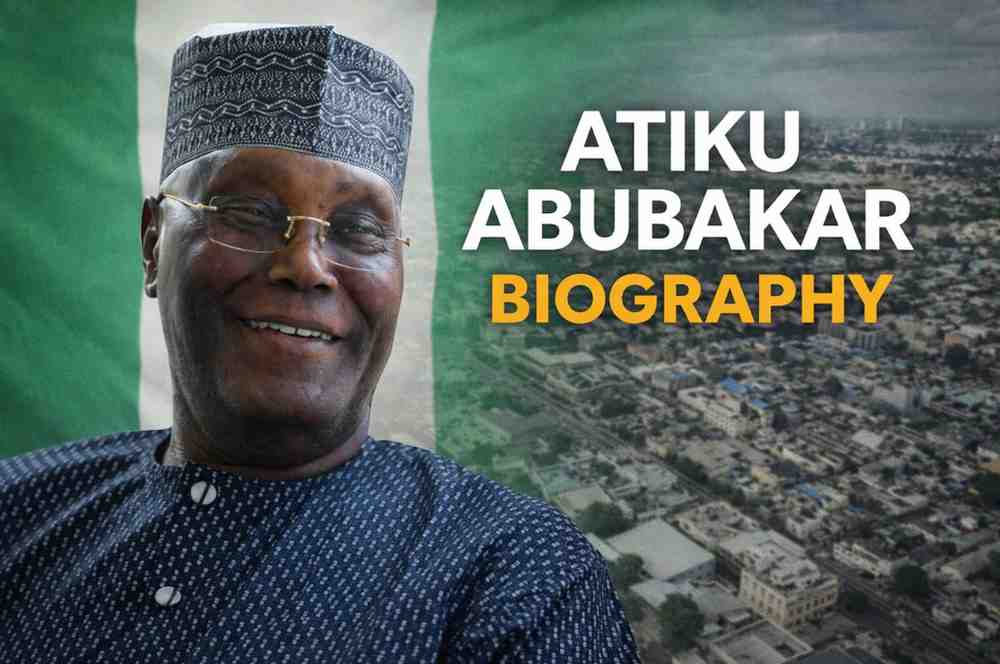
Atiku Abubakar GCON (born November 25, 1946) is a Nigerian politician and businessman who served as Vice President of Nigeria from 1999 to 2007 under the presidency of Olusegun Obasanjo. He ran unsuccessfully for governor of Adamawa State in 1990 and 1996 before winning in 1998.
Before being sworn in, he was chosen as the running mate of former military leader Olusegun Obasanjo in the 1999 presidential election and was subsequently reelected in 2003.
Atiku Abubakar ran unsuccessfully for President of Nigeria six times: in 1993, 2007, 2011, 2015, 2019, and 2023. In 1993, he ran in the Social Democratic Party’s presidential primaries but was defeated by Moshood Abiola and Baba Gana Kingibe.
In the 2007 presidential election, he ran as the Action Congress’s presidential candidate, finishing third behind Umaru Yar’Adua of the PDP and Muhammadu Buhari of the ANPP.
He ran in the People’s Democratic Party’s presidential primaries in 2011, but lost to incumbent President Goodluck Jonathan. In 2014, he joined the All Progressives Congress ahead of the 2015 presidential election and ran in the presidential primaries, losing to Muhammadu Buhari.
In 2017, he rejoined the Peoples Democratic Party and ran as the party’s presidential candidate in the 2019 presidential election, losing again to incumbent President Muhammadu Buhari.
He was re-elected as the Peoples Democratic Party presidential candidate in May 2022, this time for the 2023 general election, after defeating Nyesom Wike, the former Governor of Rivers State, in the primaries. He finished second in the general election, losing to Bola Tinubu, although Abubakar and other opposition candidates demanded a re-vote.
Abubakar quit the PDP in 2025 to join the African Democratic Congress, which included his erstwhile rival Peter Obi. The two opposition leaders want to form a unified front against the APC in the 2027 presidential election.
Atiku Abubakar Biography
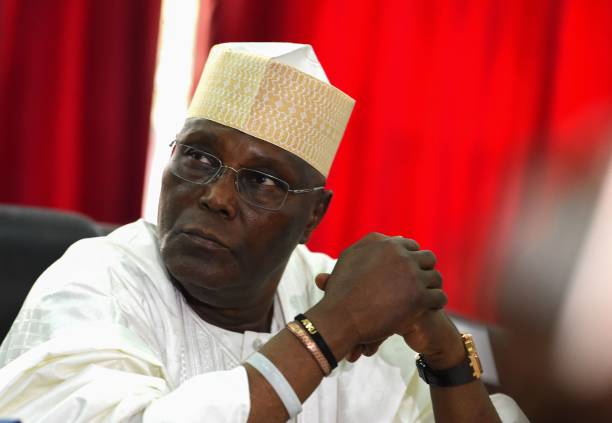
Atiku Abubakar was born on November 25, 1946, in Jada, then part of British Cameroons (now Adamawa State in Nigeria), to trader-farmer parents Garba Abubakar and Aisha Kande. He was their lone surviving child after his sister died in infancy. His father sadly drowned in 1957, leaving his mother to raise him and spark his interest in study and ambition.
Atiku Abubakar Education
His father disliked the concept of Western education and attempted to keep Atiku Abubakar out of the traditional school system. When the government learned that Abubakar was not attending the required school, his father spent a few days in jail before his mother, Aisha Kande, paid the fee.
Abubakar began attending the Jada Primary School in Adamawa when he was eight years old. After finishing primary school in 1960, he was admitted to Adamawa Provincial Secondary School with 59 other students. He graduated from secondary school in 1965 after achieving grade three in the West African Senior School Certificate Examination.
Following high school, Abubakar briefly attended the Nigeria Police College in Kaduna. When he was unable to show an O-Level Mathematics result, he left college and briefly worked as a Tax Officer in the Regional Ministry of Finance before being admitted to Kano’s School of Hygiene in 1966.
He graduated with a Diploma in 1967 after serving as Interim Student Union President at the school. On a regional government scholarship, he enrolled in the Ahmadu Bello University Institute of Administration in 1967 to pursue a Law Diploma.
He joined the Nigeria Customs Service after graduating in 1969, during the Nigerian Civil War. Abubakar graduated from Anglia Ruskin University with a master’s degree in international relations in 2021.
Career
Atiku joined the Nigeria Customs Service in 1969 and worked there for 20 years, eventually becoming Deputy Director, the second-highest position, before retiring in April 1989.
His time in Customs, particularly at Apapa Ports, paved the way for his commercial pursuits.
In the 1970s, he collaborated with Italian businessman Gabrielle Volpi to form Nigeria Container Services (NICOTES), later rebranded as Intels Nigeria Limited. In the 1970s, he co-founded Nigeria Container Services (NICOTES), later rebranded as Intels Nigeria Limited, a logistics company that became a source of income for him.
He got into real estate, erecting homes in Yola with a little loan, and in 1981, he started a 2,500-hectare maize and cotton plantation near Yola, which folded by 1986.
Other businesses include Adama Beverages Limited, which manufactures animal feed, and the American University of Nigeria (AUN) in Yola, which was established in 2005 as Sub-Saharan Africa’s first American-style private institution.
Atiku began his political career in the 1980s, working behind the scenes on Bamanga Tukur’s gubernatorial campaign in Gongola State (now Adamawa and Taraba).
He met Shehu Musa Yar’Adua, a former military second-in-command, who mentored him and recruited him to the Peoples Front of Nigeria (PFN). In 1989, Atiku was elected PFN’s National Vice-Chairman and a member of the Constituent Assembly, which drafted Nigeria’s constitution.
He stood for Gongola State governor in 1990 but was disqualified, and in 1993 he finished third in the Social Democratic Party (SDP) presidential primaries, giving way to Moshood Abiola.
In 1998, he joined the Peoples Democratic Party (PDP), won the Adamawa State governorship, and was chosen as Olusegun Obasanjo’s running mate before assuming office. He became Vice President on May 29, 1999, and served in that capacity until 2007.
As Vice President, Atiku chaired the National Council on Privatization, which oversaw the sale of state-owned firms and drove telecom, pension, and banking reforms that boosted economic growth.
His disagreement with Obasanjo over a third-term ambition led him to the Action Congress (AC) in 2006, where he ran for president in 2007 and finished third. He returned to the PDP, where he lost the 2011 primary to Goodluck Jonathan, before joining the All Progressives Congress (APC) in 2014 and losing the 2015 primary to Muhammadu Buhari.
Back with the PDP by 2017, he secured the presidential ticket in 2019 and 2023, losing to Buhari and Bola Tinubu, respectively, but he disputed the 2023 results alongside Peter Obi, citing election defects.
List of Atiku Abubakar Companies
1. Intel (Integrated Logistics Services Nigerian Limited)
Intels Nigeria Limited, one of Atiku Abubakar’s famous commercial enterprises, is a major player in the Nigerian economy. Founded in 1982 as Nicotes Services Ltd and located in Onne, Nigeria, this company has grown to become the country’s largest logistics provider, with a significant presence in the oil and gas sector. Atiku Abubakar’s involvement as a partial owner demonstrates his dedication to promoting economic growth and innovation.
The organization efficiently manages client operations, including pipe racks, stacking areas, warehousing, enclosed spaces, jetties, offices, water tanks, fuel storage, generators, compressors, and a variety of other services and facilities. By doing so, Intel ensures a comprehensive and streamlined operational environment, increasing productivity and reducing disruptions.
The company’s integrated logistics services not only make operations in the oil and gas industry more efficient, but they have also greatly increased job prospects.
2. Prodeco
Prodeco is a key component of Atiku Abubakar’s diverse commercial activities. It is divided into two parts: one for property development in Nigeria and another for oil and gas exploration in certain areas.
Prodeco began as a property development company in March 1996, and it later expanded into particular oil and gas zones through Prodeco International. It focuses on projects including buildings, the sea, and large structures. This demonstrates Atiku Abubakar’s desire for growth and improvement, since Prodeco contributes to the improvement of Nigeria’s buildings and structures. Prodeco demonstrates Atiku’s desire to improve Nigerian businesses as well as his astute thinking.
3. Atiku Abubakar Farm
In 1981, Atiku moved into agriculture, purchasing a large 2,500-hectare plot of property near Yola. This marked the beginning of a maize and cotton farming operation.
The initial years were fraught with troubles. The agricultural firm had difficulties, which resulted in its liquidation in 1986. In 2014, Atiku Abubakar openly recognized this setback, claiming that his “first attempt at agriculture in the 1980s failed.” He then focused his energies on restoring and growing his farm. Over time, his other enterprises prospered, and his farm thrived.
4. ABTI Schools
Atiku Abubakar’s devotion to education extends beyond business and politics, as evidenced by the American University of Nigeria (AUN) in Yola, Adamawa state. AUN provides a wide range of programs on its campus. Abubakar’s purpose was to impart knowledge and an environment conducive to holistic growth.
AUN was founded to improve education and encourage cross-border connections because of its proximity to Cameroon. Abubakar’s program represents his view that education leads to empowerment.
Achievements & Awards
Atiku’s vice presidency sparked economic changes, most notably the GSM revolution and financial consolidation, which created jobs and increased GDP.
His corporate empire, which includes Intel and AUN, employs thousands, with AUN receiving accolades for educational innovation.
Politically, he won 25 constitutional cases, including one that prohibits unilateral vice-presidential dismissals, strengthening democratic checks.
His generosity, like the foundation of AUN, reflects his conviction in education as a transformational force, which was molded by his own difficulties in attending school.
Personal life
Atiku, a Fulani Muslim, chose polygamy to establish a large family, blaming his lonely childhood. He has 28 offspring with five spouses, despite adhering to the Islamic maximum of four consecutive marriages. In 1971, he secretly married Titilayo “Titi” Albert (children: Fatima, Adamu, Halima, and Aminu); in 1979, Ladi Yakubu (six children, later divorced); in 1983, Princess Rukaiyatu Mustafa (seven children); in 1986, Fatima Shettima (seven children, including twins); and, after divorcing Ladi, Jennifer Iwenjiora Douglas (three children), who confirmed their divorce in 2022.
His family includes business, politics, and education, with his wives being referred to as counselors and companions. He married Fatima Shettima, his fifth wife (only his fourth legal wife at the time, due to his prior divorce from Ladi), in 1986. Their children are Amina (Meena), Mohammed, the twins Ahmed and Shehu, Zainab and Aisha, and Hafsat.
Jennifer Douglas issued a media statement on February 1, 2022, confirming her divorce from Abubakar. According to her, their union ended owing to conflicts about her ongoing presence in the United Kingdom, among other long-standing concerns.
Atiku Abubakar Net Worth
In 2025, Atiku Abubakar’s net worth is expected to be ₦120 billion, or around $81 million, based on an average exchange rate of ₦1,480 per $1. This vast wealth is the result of his extensive experience in customs, economic endeavors, real estate, education, and politics.
Social Media
X: @atiku